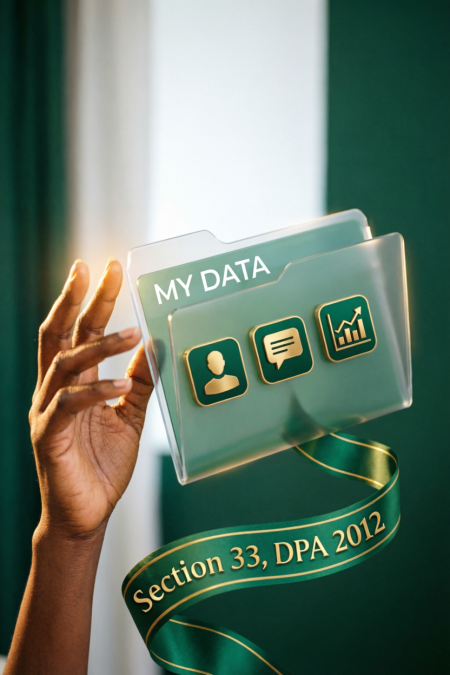
Your Personal Data Is Your Property, not a Company’s Commodity.
There is a quiet burden many individuals carry without fully recognizing it. It does not present itself as grief or exhaustion. Instead, it exists as a subtle unease, a persistent sense that something essential has been misplaced in the rhythm of modern life. Each day, we log in. We scroll. We search. We share. We click. With every digital interaction, we generate more than activity, we generate data. Not fleeting traces, but detailed, enduring records that are precise, persistent, and increasingly influential. This digital trail is far from passive. It is continuously collected, analyzed, modeled, and used to predict behavior. It shapes the advertisements we encounter, the opportunities presented to us, the content we consume, and the decisions made about us. It can influence hiring outcomes, loan approvals, insurance rates, and even the news and information placed before our eyes. Yet despite the magnitude of its impact, consent is often reduced to a checkbox. Individuals are rarely consulted when their data is reinterpreted, repurposed, copied, or sold. We are seldom notified when our information changes hands or is used in ways far removed from its original context. Instead, participation in the digital world is treated as implicit permission, our online existence framed as public infrastructure, and our personal information as a resource to be extracted. For decades, this arrangement has been normalized. We were told it was the inevitable cost of convenience. That innovation required compromise. That privacy belonged to another era. That resistance meant irrelevance.
However, beneath this acceptance has always been a quiet recognition that something fundamental was wrong, not because technology itself is harmful, but because ownership matters. Ownership is not merely a legal concept; it is a principle rooted in autonomy and dignity. And somewhere along the way, we allowed the narrative to shift. We stopped asserting ownership over our digital identities.
It is time to restate a foundational truth:
Your personal data is your property, not a company’s commodity. This is not a slogan. It is a principle. It is a recalibration of values in a data-driven age. It challenges the long-standing assumption that human identity can be reduced to an extractable asset within corporate ecosystems. Change is already underway. Not dramatically, and not without resistance, but steadily. Through stronger regulations, increased public awareness, and growing demands for transparency and accountability, individuals are beginning to reclaim control over their digital presence. The shift may be gradual, but it is decisive, like roots pressing through concrete, redefining the landscape from beneath the surface.

She did not protest loudly, nor did she abandon the platforms that structured her daily life. There was no dramatic rejection of technology, no impulsive deletion of accounts. Instead, her response was deliberate and measured. For the first time, she examined her screen not as a gateway to convenience, but as a reflection of the conditions governing her digital existence. Her attention rested on familiar words: Privacy Policy. This time, she did not scroll past them. She paused. She read, carefully enough to understand the implications, even if not every clause written in dense legal language. What she discovered was not shocking but clarifying. The agreement was not a balanced exchange between informed participants; it was a system of consent structured around asymmetry. The conversation about her data had always been happening, yet she had never truly been part of it.
From that moment emerged a simple, powerful question: What information do they actually hold about me? It was not a question rooted in fear, but in awareness. Yet once asked, it altered everything. It sharpened her perception. She began to notice patterns, the timely advertisement that mirrored a recent private conversation, the platform that anticipated preferences she had never explicitly shared, the subtle personalization that felt less like convenience and more like surveillance. These outcomes were not coincidences. They were the product of sophisticated data ecosystems designed to collect, aggregate, infer, and monetize human behavior. Location data became socioeconomic profiling. Browsing habits became predictive scoring. Digital footprints became commercial assets. The system was optimized with precision, not primarily to empower individuals, but to maximize value extraction. However, beneath this infrastructure of commodification, another force has been steadily advancing: the rule of law. Across jurisdictions, from Ghana to Kenya, from Brazil to Belgium, governments have enacted comprehensive data protection frameworks that redefine the relationship between individuals and institutions. These laws are not symbolic gestures; they are enforceable safeguards grounded in democratic accountability.
For example, Ghana Data Protection Act affirms that personal data must be processed lawfully and transparently. Kenya Data Protection Act grants individuals’ rights of access, correction, and objection. Lei Geral de Proteção de Dados in Brazil and the General Data Protection Regulation in the European Union establish clear standards for consent, accountability, and enforcement.
These legal instruments articulate rights that are both practical and profound:
- The right to know what personal data is collected and how it is used.
- The right to withdraw consent and object to certain forms of processing.
- The right to request deletion when data is no longer necessary or was unlawfully obtained.
- The right to correct inaccurate or outdated information.
These are not discretionary privileges granted by corporations. They are statutory rights, anchored in the principle that personal data belongs first to the individual. Importantly, this evolution is not anti-technology. It does not seek to dismantle innovation or retreat from digital advancement. Rather, it establishes guardrails to ensure that progress remains aligned with human dignity. Responsible data governance strengthens trust, fosters ethical innovation, and builds sustainable digital economies. The transformation underway is therefore not about withdrawal, but about recalibration. It is about refusing to exist in digital spaces as an invisible data source, tracked, analyzed, and monetized without meaningful agency. It is about shifting from passive participation to informed stewardship. It is about recognizing that identity cannot be reduced to an extractable asset within corporate ecosystems. To assert that your personal data is your property is not to disrupt the digital world; it is to humanize it. Ownership restores balance. Accountability restores trust. And awareness restores power. The future of the digital economy will not be defined solely by algorithms and analytics. It will be defined by whether societies uphold a simple, enduring principle: that human beings are not commodities, and neither is the data that represents them.