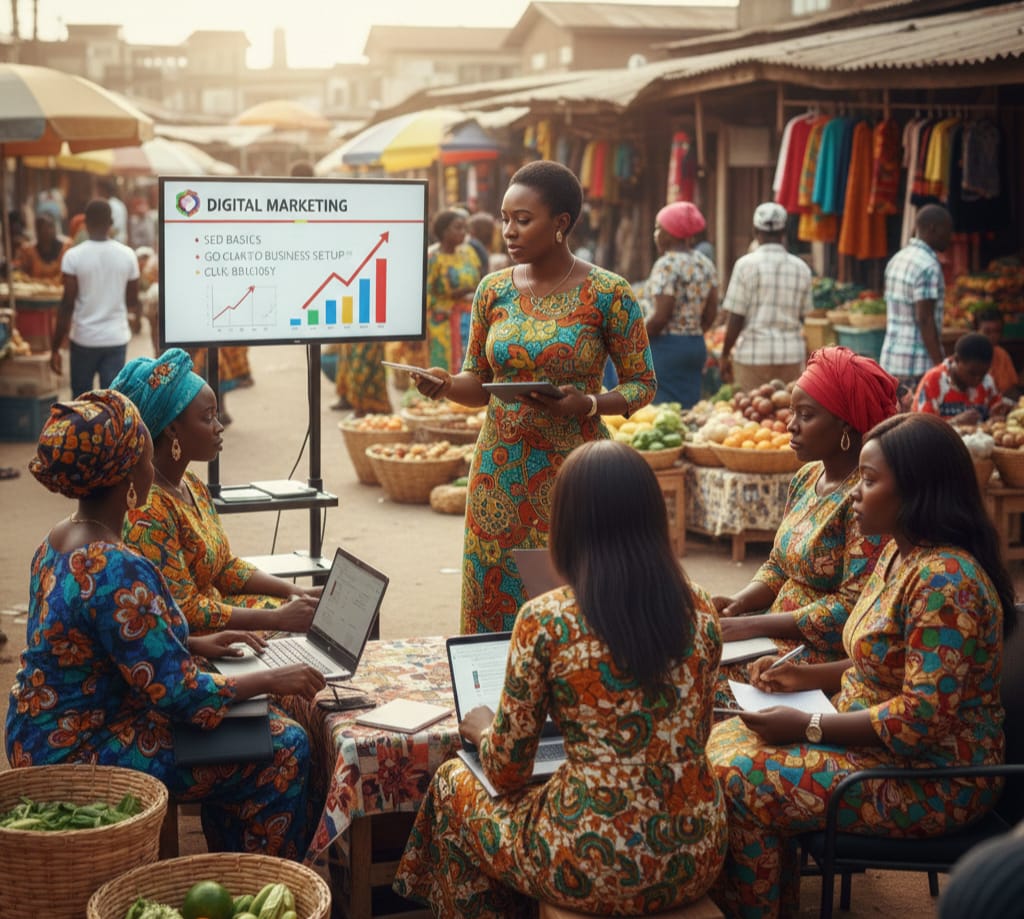
From Makola to the Digital Market (How SMEs Can Get Found Online).
Every morning, the streets of Makola Market come alive. The smell of fresh tomatoes, peppers, and spices fills the air. A woman carefully arranges her produce, greeting every customer with a practiced smile. Nearby, a seamstress threads her needle, stitching vibrant fabrics into custom garments, while a barber sharpens his clippers for his first client. These small business owners are hardworking, reliable, and deeply connected to their local communities. Yet, for all their offline presence and dedication, many of these SMEs remain invisible online. When a local customer searches for “fresh tomatoes near me” or “tailoring services in Accra,” they often find larger, digitally savvy businesses instead. The very SMEs that sustain daily life in their neighborhoods fail to appear in search results, social media feeds, or delivery platforms. Their potential for growth is limited, not by effort, but by digital visibility.
 ”
”
The Current Challenge for Local SMEs
Consumer behavior has shifted. Most people now search online before buying, even for local goods like fresh produce, pastries, or custom clothing. A customer may check Google Maps, social media pages, or delivery apps before stepping out or ordering. In this digital-first world, visibility is more than an advantage, it’s a necessity.
While connectivity has improved, with smartphones and mobile internet widely accessible, access alone is insufficient. Many SMEs have social media accounts or a basic online profile, but these are often inconsistent, unoptimized, or inactive. The result is that local customers cannot find them online, and sales are limited to foot traffic alone.
Confused SME Owner
Why Many SMEs Remain Invisible Online
The invisibility of SMEs online comes from a combination of limited digital skills, absence of strategy, and lack of targeted local outreach. Even if an SME posts occasionally on Facebook or WhatsApp, the content may not reach the right audience. Profiles may be incomplete, locations unverified, and descriptions vague. Search engines and social media algorithms favor businesses that optimize for keywords, engage consistently, and maintain credibility online.
Moreover, local customers often use terms that SMEs do not anticipate. For example, someone searching for “fresh kenkey in Accra” or “best tailor near me” may never find the business if it is not optimized for local search or mapped correctly. Many SMEs are connected but not discoverable, meaning their effort does not translate into visibility, orders, or growth.
Doing It Well: Making Digital Visibility Sustainable
Success requires more than sporadic posts or temporary exposure. SMEs must integrate access, skills, and strategy in a consistent manner. Connectivity without strategy leaves businesses invisible. Strategy without execution leaves potential untapped. We focus on digital access, skills development, and empowerment provides a roadmap. By combining structured training, mentorship, and practical implementation, SMEs can reach local audiences effectively. Over time, visibility grows, credibility strengthens, and sales increase, not only online, but also through sustained foot traffic and word-of-mouth amplified by digital presence.
How SMEs Can Get Found Locally
Transitioning from offline success to online visibility requires intentional strategy, structured skills, and continuous effort. The process involves understanding both the tools and the audience.
Key steps include:
-
Optimize Online Profiles: Create and verify business listings on Google Maps, social media platforms, and local delivery apps. Include accurate addresses, product descriptions, pricing, and high-quality images.
-
Leverage Local SEO: Use keywords that local customers are likely to search for. Include neighborhood names, product types, and local phrases in posts and profiles. For instance, “fresh tomatoes in Makola Market” will attract nearby customers searching online.
-
Engage Consistently: Post regularly on social media with updates about products, special offers, or behind-the-scenes content. Engagement encourages algorithms to show the business to more people in the local area.
-
Use Visuals Wisely: Bright, professional photos of products, stalls, or services attract attention and make posts shareable. AI-generated images or quality smartphone photos can work effectively.
-
Involve Delivery and Local Partnerships: Collaborate with local delivery services or marketplaces to ensure products reach customers beyond foot traffic. Feature these partnerships online to expand visibility.
-
Educate and Track: Business owners should learn the basics of analytics—tracking which posts, platforms, or listings drive inquiries and orders. Adjust strategies based on this data.
Training SMEs
Doing It Well: Making Digital Visibility Sustainable
Success requires more than sporadic posts or temporary exposure. SMEs must integrate access, skills, and strategy in a consistent manner. Connectivity without strategy leaves businesses invisible. Strategy without execution leaves potential untapped.
Rankdigital Foundation’s focus on digital access, skills development, and empowerment provides a roadmap. By combining structured training, mentorship, and practical implementation, SMEs can reach local audiences effectively. Over time, visibility grows, credibility strengthens, and sales increase—not only online, but also through sustained foot traffic and word-of-mouth amplified by digital presence.
SME Success
Conclusion: From Market Stall to Digital Success
Connectivity alone is not empowerment. SMEs must transition from being online to being visible, from presence to discoverability, and from awareness to competitiveness. The local market woman, the seamstress, the barber, and other small business owners can thrive digitally when access, skills, and strategy come together.
The key question for readers and stakeholders is this: Are we supporting SMEs only with access, or are we equipping them to be discovered, trusted, and competitive in a digital-first local economy?
Empowering local SMEs means bridging the gap between offline success and online visibility, ensuring that every small business—from Makola Market to beyond—can be found, trusted, and chosen by local customers searching online.