AI is Powerful… But It Still Needs Humans
Do you ever stop to think about whether AI can truly work alone? Artificial Intelligence has become part of our everyday lives, from chatbots that answer customer questions to smart tools that help us create content, design graphics, and analyze data. On the surface, AI seems almost magical; it can handle thousands of tasks in seconds, generate solutions, and even produce ideas that sometimes feel creative.
But here’s the truth: AI cannot replace humans. No matter how advanced it becomes, AI still needs humans to guide it, ask the right questions, and provide context. Without human input, AI is like a race car with no driver, it has speed and power, but it doesn’t know where to go.
AI is fast. Humans give it the why.
AI is incredibly efficient. It can sort data, analyze patterns, and generate outputs faster than any human could. For example, an AI tool can scan thousands of documents in seconds to find trends or inconsistencies. It can suggest marketing strategies, create draft content, and even propose solutions to complex problems. But without humans to review, refine, and interpret these outputs, they can be incomplete, misleading, or even nonsensical. Humans bring understanding, insight, and context, qualities that no AI algorithm can replicate.
Consider the creative process. AI can generate a beautiful image or suggest a catchy caption, but it cannot understand emotional resonance, cultural nuance, or brand tone in the way a human can. AI may give options, but humans decide which options are meaningful, relevant, and effective. This collaboration between speed and judgment is where the real power lies.
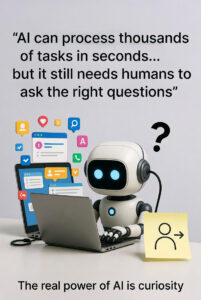
Imagine a friendly robot at a desk, juggling dozens of tasks at once. It can organize spreadsheets, suggest ideas, and even write drafts of reports. But a human steps in to point it in the right direction, to clarify priorities, and to make decisions. That human input transforms the AI’s output from raw data into actionable, meaningful results.

Humans + AI = better ideas
The applications of this human-AI collaboration are everywhere. Entrepreneurs can use AI to brainstorm marketing campaigns, but they must refine these campaigns with their creativity and knowledge of their audience. Students can use AI to research topics quickly but understanding and applying that knowledge requires human judgment. Professionals can rely on AI to process complex data, yet they make the final decisions based on ethics, experience, and strategic thinking.
Even in more playful scenarios, the principle holds. Think about AI-powered tools in gaming or content creation. AI can suggest storylines, generate levels, or design characters, but it’s the human player or creator who guides the choices, injects personality, and decides what is fun, meaningful, or impactful. Without humans, AI’s “creativity” has no direction or purpose.
The best way to use AI is to treat it as a teammate. Let it handle repetitive, time-consuming, or complex tasks, but always guide it with your ideas, questions, and judgment. This is where AI shines: it amplifies human abilities instead of replacing them. By giving AI direction, humans can focus on creativity, problem-solving, and decision-making.

Guide the AI. Reach the idea
In the end, AI is a tool, a fast, clever, and capable tool, but it works best when humans lead the way. The combination of human insight and AI efficiency creates something neither could achieve alone. Humans bring curiosity, creativity, and judgment. AI brings speed, analysis, and scalability. Together, they become a superpower that allows us to innovate, solve problems, and create meaningful results.
As we move into a future where AI becomes increasingly powerful, it’s essential to remember that technology alone is not enough. It’s the collaboration between humans and AI that will drive innovation, learning, and growth. By embracing this partnership, we unlock a world of possibilities and make work not only more efficient but also smarter, more creative, and far more impactful.